From virtual to reality: D.C. lab actually makes things
Premium content from Washington Business Journal by Bill Flook, Staff Reporter
Date: Friday, June 15, 2012, 6:00am EDT
One of the coolest things happening in D.C. tech is popping up in the middle of a struggling neighborhood a few blocks north of New York Avenue on North Capitol Street.
Step into Fab Lab D.C.`s interior, and you`ll find a digital fabrication lab bubbling with volunteers. Anchored by three big machines and sprinkled with artsy knickknacks, the space has a blue-collar workmanlike ambiance mingled with aspects of a college computer lab and sculptor`s studio.
Think of the nonprofit startup lab as a bridge between the abstract and the tangible. Want to create a prototype for a new belt buckle or car part? Fab Lab`s 3-D printer can extrude it, layer by layer, in molten plastic. The vinyl cutter can carve out professional signs or decals. The mini-mill can carve out circuit boards as easily as it can a pint-sized Eiffel Tower.
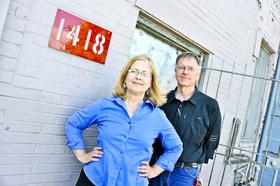
Phyllis Klein, a freelance consultant and long-time community organizer, launched Fab Lab with help from the Massachusetts Institute of Technology , which lent the equipment and maintains an international network of fab labs.
The project is in its infancy, held together by modest donations, volunteer labor and bootstrapping. But the mission, broadly speaking, is to put the means of small-scale manufacturing into the hands of the average artist, inventor, architect, student or amateur tinkerer.
“There`s something in the developing, where it really allows you to hone your idea,“ Klein said. “Even though the virtual world is wonderful — and we use it everyday — we still live in the physical world. And there`s still a lot of problems to be solved by making things.“
Klein and her team of about 50 volunteers are now on the hunt for roughly $150,000 to buy more equipment and hire one or two full-time managers, as well as keep the lights on.
What she needs is a business model, not so much to make money but to sustain the operation. So far, the facility has been pretty much limited to hosting school and workshop groups and speakers.
 Bates Area Civic Association