See this post from Urban Turf:
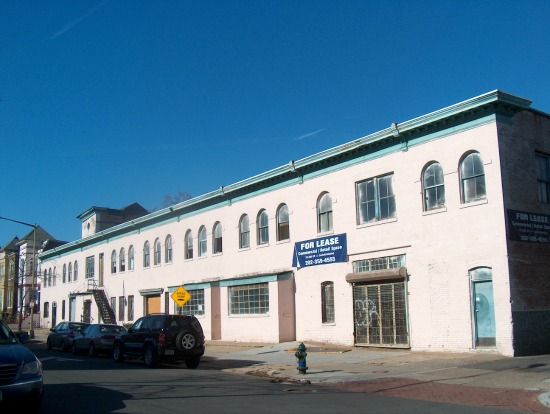
Former Brass Knob Warehouse Saved From Demolition
April 1, 2013
by Shilpi Paul
Chapman Stables, a property that spans three lots near 37-57 N Street NW, has been partially saved from demolition.
Plans were in the works to raze the Truxton Circle site, which was previously home to the Brass Knob warehouse, to make room for a new development in the increasingly-popular area. However, the DC Preservation League also submitted an application to the Historic Preservation Review Board (HPRB) to designate the buildings as historical landmarks, a status that would mandate a secure future.
In a bit of drama, the two groups were both on the agenda of last Thursday’s HPRB meeting. The committee made a decision that may satisfy both parties: a portion of the complex — a garage and stable at 37-57 N Street NW — will be entered into the DC Inventory of Historic Sites with the title Chapman Coal Company Stable and Garage.
The remainder — 54-64 and 66-76 Hanover Place NW — will be not deemed a historic landmark, and are presumably free to be razed.
The historical value of the saved structures, which were built in 1908 and 1912, hinges on their evolution from a coal yard with stables to a car and bus garage, capturing the transition from horses to automobiles.
“6 years after Chapman built his first stable, The Washington Post announced: The horse is done,” said a representative from DC Preservation League at the HPRB hearing. “Chapman then evolved, retooling the stables into garages.”
The structures also harken back to a time when DC’s alleys were bustling with activity.
From the Staff report:
“While hundreds of private and commercial garages were built in the city beginning around the turn of the 20th century, Chapman’s Garage is one of a handful of known surviving early 5 purpose-built commercial garages. Chapman Stable and Garage is significant in terms of the city’s historic commercial development and as an important representation of the rise of the automobile on the city’s built environment.”

 Bates Area Civic Association