I have copied in the first few paragraphs of this Washington Post book review item. Click on the article link to read the entire item.
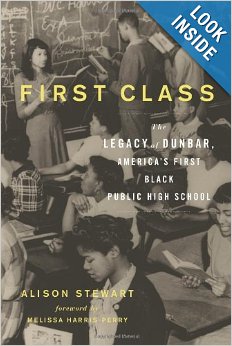
‘First Class: The Legacy of Dunbar, America’s First Black Public High School’ by Alison Stewart
By T. Rees Shapiro, Published: January 17
One day in May 1954, classes at the District’s Dunbar High School were interrupted by the principal’s voice crackling through the loudspeakers. “He said the Supreme Court of the United States just declared school segregation to be unconstitutional,” Eleanor Holmes Norton, a graduate of the Class of 1955 and now the D.C. delegate to the U.S. House of Representatives, told journalist Alison Stewart. The significance of the news was not lost on Norton nor any other student in the all-black school. “It was a moment that nobody who was there would ever forgot,” she recalled. “There were teachers who nearly cried. It was the kind of announcement you’d make at Dunbar and everyone . . . would understand what it meant to us.”
What it meant, Stewart explains in her new book, “First Class,” was that Dunbar would never be the same. From that moment forward, she writes, the school’s reputation as a sterling institution of black education that produced Army generals, surgeons and civil rights leaders was diminished.
The school is now known as one of the most troubled in the District. Dunbar has persistent truancy issues, and fewer than one-third of the students are proficient in reading. Only six in 10 students graduate on time, and only four in 10 make it to college. Stewart notes that, at the time of the 1954 Brown v. Board of Education Supreme Court ruling, Dunbar High sent 80 percent of its graduates to college — the highest rate of any school in the District, black or white.
Stewart traces the school’s decline by beginning with the history of black education in Washington and Dunbar’s remarkable start as the nation’s first public high school for African Americans. Founded in 1870 as the Preparatory High School for Colored Youth, the school benefited from a well-trained faculty in its early years, thanks to the prescient efforts of Myrtilla Miner.
 Bates Area Civic Association